K-PARD · An Alterra Solutions R&D project
Keeping a fast drone in sight
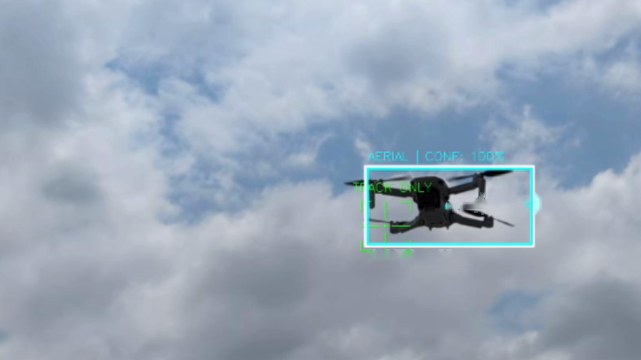
K-PARD detects small, fast drones in camera images, tracks them and follows them with a moving turret. All processing runs on a computer in the field; no internet connection or cloud service is needed.
Why is it hard?
Most drones in the published drone-detection datasets hover or drift past slowly. A fast FPV drone covers dozens of times its own size every second. Common methods can't hold on to a target at that speed.
37×
In the FPV profile we design for, a drone moves about 37 times faster, relative to its size, than the typical drone in public datasets.
Boxes stop overlapping
Common trackers recognise a target by the overlap of its boxes in two consecutive frames. At this speed the boxes no longer overlap and the track breaks.
Zooming doesn't help
Zoom or higher resolution makes the drone bigger, but its jump from frame to frame grows by the same factor. The problem is not the camera; it is how the target moves.
How it works
01
Motion detection
Picks up small moving points in the sky as candidates.
02
AI verification
An object detection model looks only at the area around each candidate and checks whether it really is a drone. False alarms are filtered out here.
03
Tracking
The target is followed from frame to frame by tracking image motion and predicting its next position. If it disappears for a few frames, the prediction keeps following it.
04
Turret
A two-axis turret keeps the target in the centre of the frame. If the link to the computer drops, it holds its position and does not move on its own.
Measure first
Every camera frame is recorded together with the angle sent to the turret at that moment, so it is always possible to see afterwards what the system was following and when.
Tracking methods are tested on synthetic footage with controlled, increasing speed and on published real-world datasets, and we measure at what speed each one breaks. A change goes into the system only if it improves that measurement.
Where it stands
K-PARD is an R&D prototype. The measurement pipeline and the live tracking loop work, and the first field trials are done. Development continues towards the speed and accuracy we are aiming for.
If you work in defence or security and are considering a field trial or joint development, get in touch.
Contact us